
informational 6 min read
Venus de Milo: Sculptor, History, Arms and Where to See It
Updated October 28, 2026
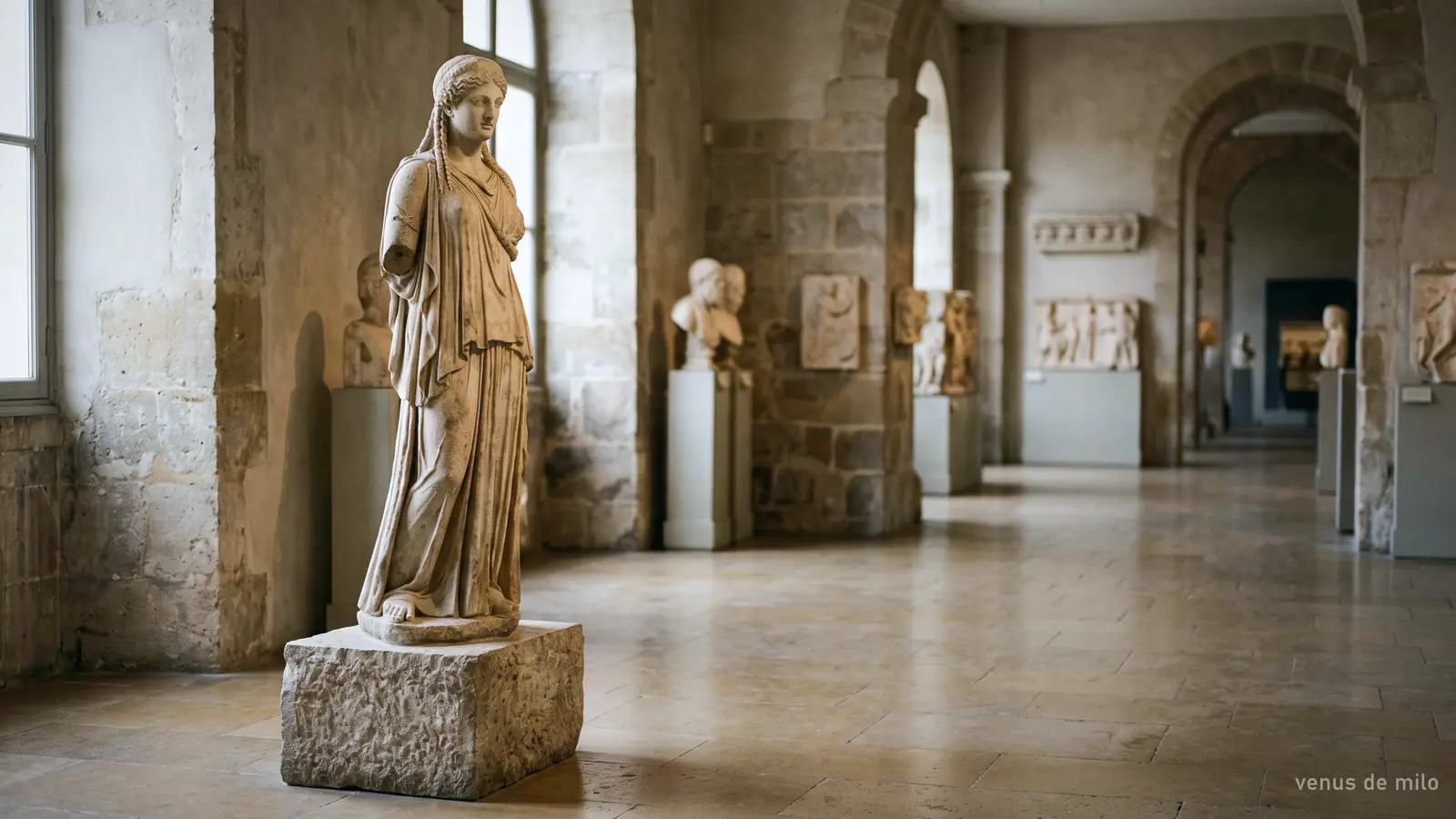
The Venus de Milo is a Greek marble statue from the Hellenistic period that, in the majority view, depicts Aphrodite, the goddess of love and beauty (Venus to the Romans). It was found in 1820 on the island of Milos, in the Cyclades, and has been in the Louvre Museum since 1821. You can see it in room 345 of the Sully wing, level 0. Its sculptor is unknown and both of its arms are missing.
What is the Venus de Milo and what does it depict?
It is a free-standing sculpture of a half-naked woman, with a cloak covering her legs. The Louvre’s record lists it as Aphrodite. Spanish Wikipedia explains that the missing arms have made it hard to identify: most see it as Aphrodite because of the partial nudity, but it has also been suggested that it was Artemis with a bow, a Danaid with an amphora or Amphitrite with a trident, a goddess much worshipped on Milos itself.
The name “de Milo” comes from the island where it was found, Milos or Melos.
Who made the Venus de Milo?
Nobody knows. Fragments with inscriptions naming artists from Antioch turned up near the statue, which is why the name Alexandros of Antioch has been suggested, but there is no evidence that those inscriptions belong to this statue rather than to other pedestals, according to Spanish Wikipedia. The Louvre’s record gives no sculptor.
What there is, is a date: the Louvre places it in the third quarter of the 2nd century BC, between 150 and 125 BC, in the Hellenistic period. Spanish Wikipedia gives a slightly later range, between 130 and 100 BC.
How tall is it and what is it made of?
| Fact | Detail (Louvre record) |
|---|---|
| Height | 2.04 m |
| Material | Parian marble |
| Date | 150–125 BC (Hellenistic) |
| Find spot | Milos (Melos), 1820 |
| Entered the Louvre | 1821, as a gift |
| Catalog number | Ma 399 (also LL 299 and N 527) |
| Location | Room 345, Sully wing, level 0 |
Spanish Wikipedia gives a height of about 2.11 m; the figure in the table is the museum’s. The statue is made of two blocks joined at the hips, and the left arm was a separate added piece, according to the Louvre. It also wore bronze ornaments: there are holes for a diadem and for a bracelet on the right arm.
Where and when was the Venus de Milo found?
A farmer on Milos, Yorgos Kendrotas, found it half-buried and broken in two on April 8, 1820, according to Spanish Wikipedia. Greece was then under Ottoman rule.
The French naval officer Jules Dumont d’Urville recognized its value, and the purchase was closed by the French ambassador in Constantinople, the Marquis de Rivière. There was a dispute, because the farmer had earlier agreed to sell it to the Turks. The statue left Greece on March 1, 1821, was presented to King Louis XVIII that same year, and the king gave it to the Louvre.
The timing helped its fame. In 1815 France had had to return to Italy the Venus de’ Medici, which Napoleon had brought to Paris, and the Venus de Milo was presented as an even greater treasure, according to Spanish Wikipedia.
Why does the Venus de Milo have no arms?
Because they were lost and have never been put back. What is known and what is not:
- What is established: the Louvre’s record says the left arm, much of the right arm and the left foot are missing. A fragment of a forearm and a hand holding an apple were found next to the statue and are considered part of its arms (Spanish Wikipedia).
- What is unclear: whether the arms were lost in antiquity or after the discovery. Spanish Wikipedia records accounts according to which they broke when it was taken off the island, but none is proven.
- What they were doing: this is a hypothesis. It has been suggested that the right arm held the cloak at hip level and that the left held the apple from the Judgment of Paris, or a mirror, a shield or a wreath.
After it arrived in France, it was decided not to restore the arms, because nobody knew what position they had been in. The nose, the left foot and a plinth were added. In the restoration from November 2009 to April 2010 the plaster additions were removed and the surface was cleaned, according to Spanish Wikipedia.
Where is the Venus de Milo in the Louvre?
In room 345 of the Sully wing, level 0, the room of classical and Hellenistic Greek art that the museum itself identifies by her name. The record lists it as displayed outside a case.
During the Second World War it was protected at the Château de Valençay, and in 1964 it traveled to Japan, where it was damaged, according to Spanish Wikipedia.
With general admission (22 € for residents of the European Economic Area and 32 € for everyone else, with a reserved time slot) you can see it at no extra cost. The Winged Victory of Samothrace is on level 1 of the Denon wing: here is the story of the Winged Victory of Samothrace, and the Louvre map shows how to link the two.
If you want to see the Venus de Milo alongside the museum’s other great works in a single morning, see what to see at the Louvre or the most famous sculptures in the Louvre. And if you would rather go with a guide, the Louvre guided tour includes admission.

Check prices & dates
Book your tickets in advance: popular time slots sell out.
Book tickets
From$66per person
Check availability- Free cancellation up to 24 h before on 9 of 10 options
- Louvre entry included in all of them
- Prices in US dollars
Price checked Oct 27, 2026
Sources