
informational 6 min read
Winged Victory of Samothrace: What It Is and Where to See It
Updated October 28, 2026
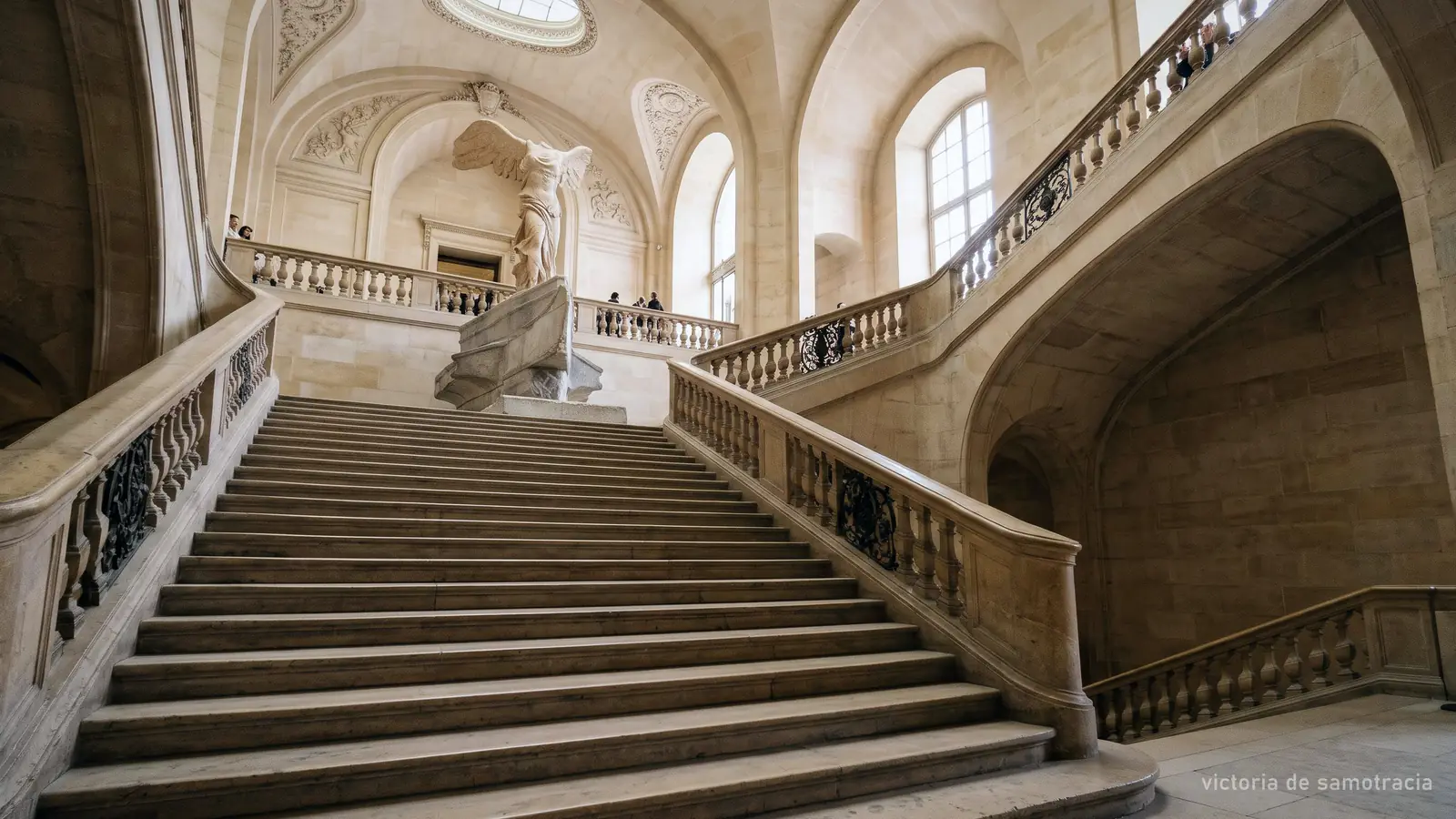
The Winged Victory of Samothrace is a Greek marble statue of Nike, the goddess of victory, alighting with wings spread on the prow of a ship. It dates from the Hellenistic period, between 200 and 175 BC according to the Louvre, and was found in 1863 on the Greek island of Samothrace. Today the Winged Victory presides over the landing of a staircase in the Denon wing, room 703, level 1, at the Louvre Museum. Its head and arms are missing, and its sculptor is not known for certain.
What is the Winged Victory of Samothrace and what does it depict?
It is a sculpture of Nike, the Greeks’ winged Victory, who seems to have just landed on the prow of a ship. She wears a thin chiton and a cloak that the wind presses against her body, revealing the anatomy beneath. Spanish Wikipedia links this treatment of the fabric to the “wet drapery” technique attributed to Phidias.
The monument celebrated a naval victory. When it was discovered it was thought to commemorate the triumph of Demetrius Poliorcetes at Salamis in 306 BC, because a similar figure appears on his coins from 294 to 288 BC. The date it is given today, the early 2nd century BC, makes a link to the victories over Antiochus III more logical, according to Spanish Wikipedia.
Who made the Winged Victory of Samothrace and when?
There is no certain sculptor. Spanish Wikipedia places it in the Rhodian school and notes that some experts attribute it, with some probability, to Pythokritos of Rhodes. The Louvre’s record gives Rhodes as the place of creation, with a question mark, and names no sculptor.
| Fact | Detail |
|---|---|
| Date | 200–175 BC (Louvre); around 190 BC (Spanish Wikipedia) |
| Material | Parian marble (statue) and Lartos marble (ship and base) |
| Height of the figure | 2.75 m (Spanish Wikipedia) |
| Find | Samothrace, sanctuary of the Cabiri, 1863 |
| Catalog number | Ma 2369 |
| Location | Room 703, Palier Samothrace, Denon wing, level 1 |
Why does the Winged Victory of Samothrace have no head?
Because it has not survived. The Louvre’s record lists what is missing: the head, the neck, both arms, the left side and back of the bust, the right wing, the right foot, the left calf and foot, and the lower part of the drapery at the back. None of the sources consulted explains when or how the head was lost.
What you see today is not all original. According to the Louvre, the left breast, the belt area, the back of the bust and the right wing were remade in plaster, and the wings are held up by a metal frame. In the latest restoration, in 2014, two feather fragments and nine fragments of the base were put back.
What did the complete Winged Victory look like?
It was a monument, not just a statue. The figure stood on the prow of a marble ship that served as its pedestal; the base is made of 16 blocks in three courses and rests on a plinth of 6 slabs, according to the Louvre. The bust and the wings were carved separately and joined afterward.
There is no certainty about the arms and head, so any reconstruction is hypothetical. What survives is the composition: the goddess alighting on the prow, her body in a slight twist and her clothes whipped by the wind, according to Spanish Wikipedia.
How did it reach the Louvre?
It was discovered in 1863 by Charles Champoiseau, French consul and amateur archaeologist, in the sanctuary of the Cabiri on Samothrace, according to Spanish Wikipedia. It reached the museum in parts: the Louvre’s record shows arrivals in 1864, 1879 and 1891. One of the base blocks stayed in Greece and is kept in the Samothrace museum.
Its fame went beyond ancient art. In the 1909 Futurist Manifesto, Marinetti wrote that “a racing car is more beautiful than the Victory of Samothrace”, and the artist Yves Klein made a small version in his signature blue.
Where is the Winged Victory of Samothrace in the Louvre?
In room 703 of the Denon wing, level 1, the landing the museum calls Palier Samothrace, at the top of a staircase. The Mona Lisa is on the same level of the Denon wing, in room 711, so you can see both on the same route. We lay it out for you on the Louvre map.
General admission (22 € for residents of the European Economic Area, 32 € for everyone else, with a reserved time slot) includes the Winged Victory. The Louvre opens 9:00 a.m. to 6:00 p.m., until 9:00 p.m. on Wednesdays and Fridays, and is closed on Tuesdays.
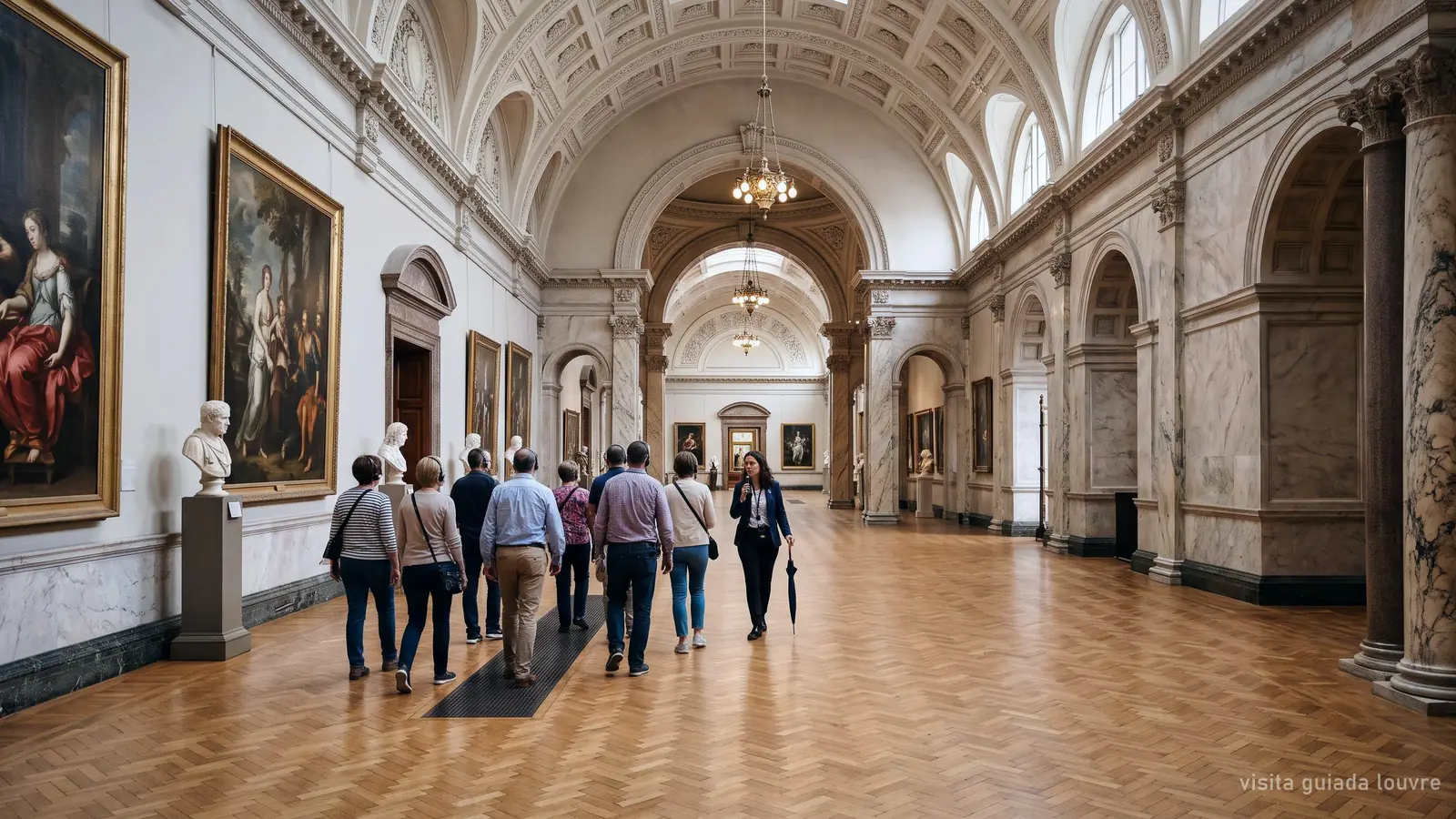
The museum’s other great Greek sculpture is in the Sully wing: read the story of the Venus de Milo. And for a full list of what not to miss, see the must-see works at the Louvre or the museum’s most famous sculptures. If you would rather have a guide take you to the Winged Victory, the Mona Lisa and the other masterpieces, the Louvre guided tour includes admission.
Check prices & dates
Book your tickets in advance: popular time slots sell out.
Book tickets
From$66per person
Check availability- Free cancellation up to 24 h before on 9 of 10 options
- Louvre entry included in all of them
- Prices in US dollars
Price checked Oct 27, 2026
Sources