
informational 7 min read
Mona Lisa: Who Painted It, How Big It Is and Where to See It
Updated October 28, 2026
The Mona Lisa, also called La Gioconda, is an oil portrait that Leonardo da Vinci began in Florence around 1503 and kept working on until 1519, the year he died. It shows Lisa Gherardini, wife of the Florentine Francesco del Giocondo, and measures 79.4 × 53.4 cm. It hangs in the Louvre Museum in Paris, in room 711 (Salle des États) of the Denon wing, level 1, under inventory number INV 779.
Who painted the Mona Lisa and who is the woman in the portrait?
It was painted by Leonardo da Vinci, born in Vinci, near Florence, in 1452, who died in Amboise (France) in 1519. The Louvre’s catalog entry attributes it to him without doubt and explains that he began it around 1503, “no doubt” for Francesco del Giocondo, but kept it until the end of his life to go on painting it: when he died, it was still unfinished.
The woman is Lisa Gherardini (Florence, 1479–1542). The Louvre says so clearly: a solid tradition, dating back to the 16th century, makes it certain that the portrait shows her. The alternative identities that have circulated since the 20th century are put forward by people with no documentary support, according to the same entry.
The official title the museum uses sums it all up: Portrait of Lisa Gherardini, wife of Francesco del Giocondo, known as La Gioconda or Monna Lisa.
Mona Lisa or La Gioconda: why does it have two names?
Both names refer to the same painting, and both come from the sitter:
- Gioconda comes from her husband’s surname, Giocondo. In Italian the word also means “cheerful” or “jovial”, according to Spanish Wikipedia. In French it is called La Joconde.
- Mona Lisa comes from Monna Lisa: monna meant “lady” in old Italian, so it means “Lady Lisa”.
In English it is almost always “Mona Lisa”; in Spain people more often say “la Gioconda”. There are not two versions in the Louvre: it is a single painting.
How big is the Mona Lisa and what technique was used?
It measures 79.4 cm high and 53.4 cm wide, according to the Louvre’s catalog entry; with the frame, 1.01 × 0.77 m.
| Fact | Detail |
|---|---|
| Artist | Leonardo da Vinci (1452–1519) |
| Date | 1503–1519 |
| Medium | Oil on poplar panel |
| Dimensions | 79.4 × 53.4 cm (101 × 77 cm with frame) |
| Inventory | INV 779 (also MR 316) |
| Location | Room 711, Salle des États, Denon wing, level 1 |
| Acquisition | Former royal collection, in the museum since 1793 |
The technique is sfumato: Leonardo gives up sharp outlines and wraps face and landscape in a kind of haze that softens the contours, as Spanish Wikipedia explains. The original colors are harder to see today because the varnishes have darkened. The panel has a 12 cm vertical crack in its upper half, repaired between the mid-18th and early 19th centuries with two metal pieces on the back, and stable, according to the same source.
Why is the Mona Lisa in France and not in Italy?
Because Leonardo took it with him to France and it stayed there. At the end of his life the painter worked for King Francis I and died in Amboise in 1519. According to the Louvre’s entry, the king “very probably” acquired it in 1518; Spanish Wikipedia notes that it is unclear whether the purchase came before or after the artist’s death.
Since then it has belonged to the Crown and later to the French State. It passed through Fontainebleau, Paris and Versailles, and reached the Louvre with the Revolution. Napoleon Bonaparte kept it in his bedroom in the Tuileries Palace between 1800 and 1804. During the Second World War it was protected outside Paris, at the Château d’Amboise and the Abbey of Loc-Dieu.
Why is the Mona Lisa so famous?
There is no single reason. According to Spanish Wikipedia, its fame rests on its technique, its many literary references, the theories about the sitter and, above all, the 1911 theft: on August 21 that year a former museum worker took it off the wall and walked out with it, and the painting was gone for more than two years. We tell that story in the 1911 Mona Lisa theft.
Add to that the reproductions, the parodies and the works it has inspired. If you want to compare it with the copy kept in Madrid, read the Prado Mona Lisa versus the Louvre’s.
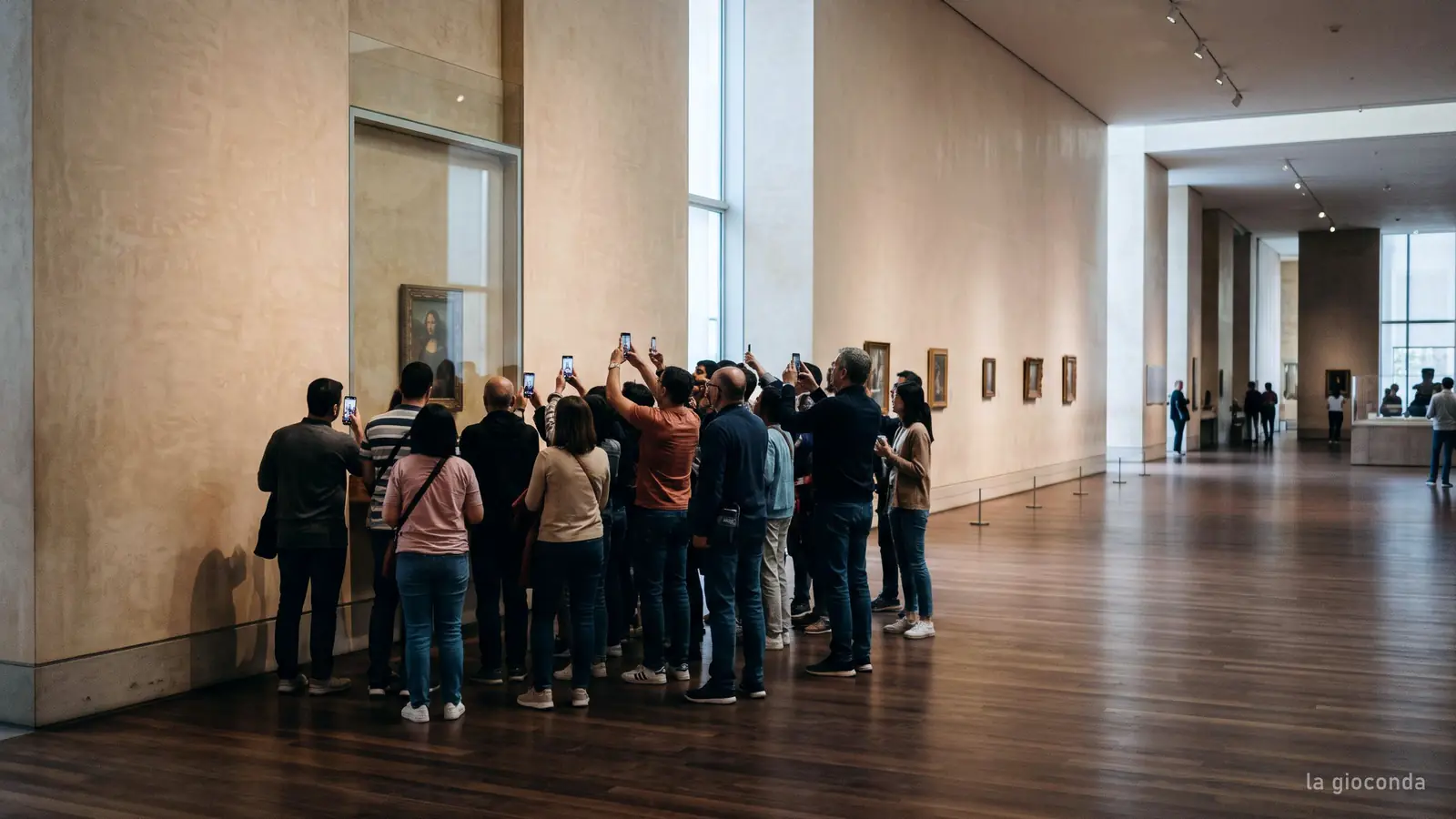
Where is the Mona Lisa in the Louvre and how do you see it?
It is in room 711, the Salle des États, on level 1 of the Denon wing. It has been in that room since 2005; before that it hung in the so-called Salle Rose, according to Spanish Wikipedia. Veronese’s The Wedding at Cana hangs in the same room, according to the Louvre’s entry for that work. We explain the route from the Pyramid in where is the Mona Lisa.
The painting sits behind 40 mm anti-reflective bulletproof glass, in a case kept at 20 °C and 50 % relative humidity (Spanish Wikipedia).
To get in you need a general admission ticket: 22 € if you are a national or resident of the European Economic Area and 32 € for all other visitors, with a reserved time slot. The museum opens 9:00 a.m. to 6:00 p.m. on Mondays, Thursdays, Saturdays and Sundays, until 9:00 p.m. on Wednesdays and Fridays, and is closed on Tuesdays.
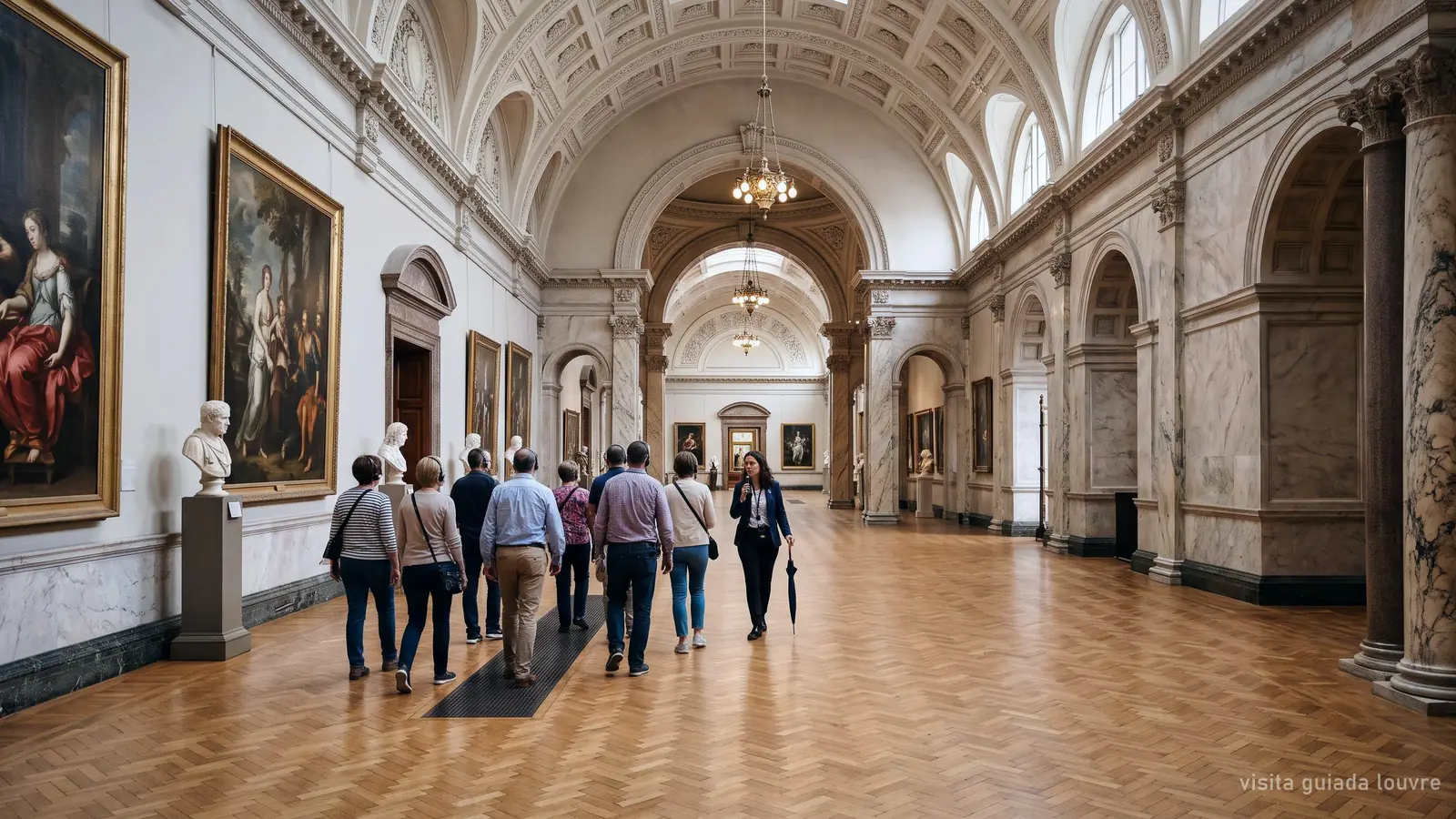
If you would rather have someone take you straight to her and explain the context, a guided tour of the Mona Lisa and the masterpieces includes admission and covers room 711 with a guide. For a wider route, see what to see at the Louvre.
Check prices & dates
Book your tickets in advance: popular time slots sell out.
Book tickets
From$66per person
Check availability- Free cancellation up to 24 h before on 9 of 10 options
- Louvre entry included in all of them
- Prices in US dollars
Price checked Oct 27, 2026
Sources